
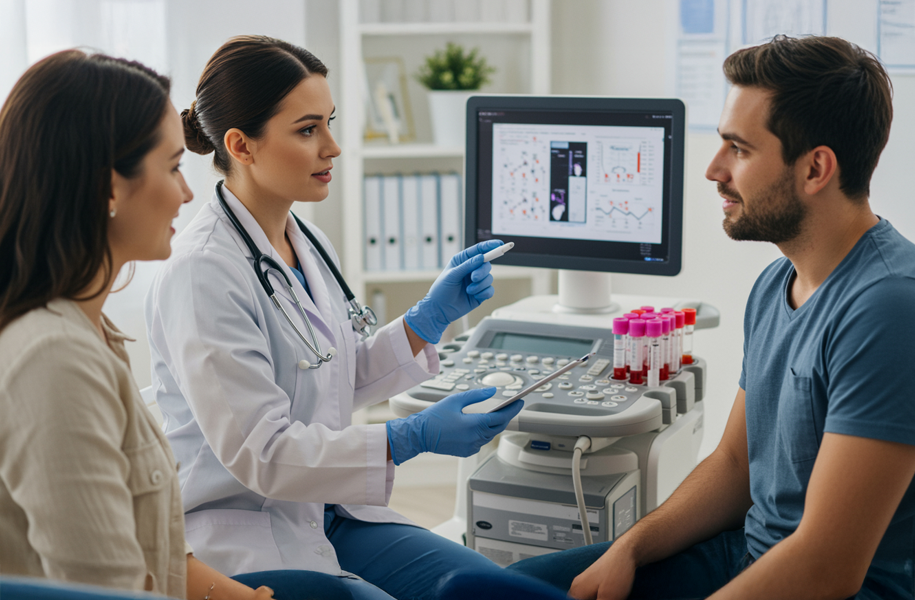
Fertility tests help understand reproductive health before starting treatment. They use advanced tests like hormonal checks, ultrasound, and semen analysis. This way, specialists can spot issues that might stop conception and plan a custom treatment.These tests are key in modern fertility care. They give precise information that shapes the IVF journey. With these tests and the latest diagnostic tools, patients get a treatment plan made just for them. This plan aims to boost success rates and support their path to pregnancy.

Fertility evaluation is essential for understanding reproductive health and guiding treatment decisions. Comprehensive diagnostic testing has become the standard approach for assessing fertility potential.
A detailed review of medical history, hormone testing (AMH, FSH, LH, estradiol), and menstrual patterns to understand ovarian function and overall reproductive health.
Transvaginal ultrasound is performed to assess antral follicle count, uterine structure, and ovarian reserve—key indicators for planning an effective fertility treatment.
Diagnostic testing for IVF provides essential insight into reproductive health before treatment begins. Through hormone evaluations, ovarian reserve measurements, ultrasound imaging, and semen analysis, specialists gain a clear understanding of the factors influencing fertility and can develop a personalized plan for successful assisted reproduction.
These diagnostic methods have become a trusted foundation of modern IVF care, offering consistent accuracy across every stage of evaluation. As technology has advanced, testing techniques have improved while maintaining the principles that guide fertility specialists today. With comprehensive assessments and detailed reporting, diagnostic testing continues to support effective decision-making and remains central to achieving positive IVF outcomes.